
Finding Dallas Resident Records
No single public roll lists every Dallas resident. So the search starts with whatever fact you already hold. A street address points to the Dallas Central Appraisal District, or DCAD, where a parcel card names both the property and its owner. A name can be run through the Texas voter-status tool, a court party index, or an older city directory. Each source answers a narrower question.
The County Clerk deed index shows parties to recorded transactions. A directory places a household at an address in a given year. Keep the result, its date, and its office together in your notes. A DCAD mailing address may differ from the situs address, which is the land itself. A court hit identifies a party, not a neighbor. For an older home, the Dallas Public Library offers directories, newspapers, maps, and local-history files that add the time layer a current parcel card cannot.
- Search DCAD by owner name or street address and save the account number, property address, legal description, and each address label.
- Use the Texas voter-information lookup for a registration-status check when its identity fields fit the person.
- Search Dallas County Official Public Records by grantor, grantee, subdivision, document type, or document number.
- For a past household, ask Dallas History & Archives for the relevant directory, newspaper, yearbook, or map collection.
- When a needed city record is not online, send a specific written request through the City Secretary or the responsible Dallas department under the Texas Public Information Act.
Dallas Resident Records Offices
Dallas records sit across city, county, and state custody. Deeds and official records belong to the Recording Division. Appraisal-account data and parcel mapping live at DCAD. Voter status runs through the Secretary of State, while Dallas County Elections handles county registration questions. Permits, municipal citations, archives, and city-limit vital records stay with the city. Ask the office that created the record, since a city request will not pull a County Clerk file.
Dallas County Clerk Recording
500 Elm Street, Suite 2100
Dallas, TX 75202
214-653-7099
Dallas Central Appraisal District
Property and parcel accounts
Separate from the County Clerk
Use the DCAD contact route
Note: County pages report building repairs, so call ahead before any in-person Dallas records visit.
Dallas Property Roll Fields
DCAD is the first address-based stop for most Dallas resident lookups. The owner screen offers Last Name and First Name fields. Account types cover Residential, Commercial, and BPP. The address screen breaks down number, direction, street name, building, suite, city, range, and account type. A property result may show the account number. It can also list the owner, mailing address, situs address, legal description, values, exemptions, and taxing jurisdictions. An exemption is a useful clue. It does not prove anyone lives there today.
| DCAD field | Format | Why it matters |
|---|---|---|
| Owner last name | Required, two or more characters | Searches an owner-name account record |
| Street name | Two or more characters, no spaces | Starts an address search |
| Number from and to | Numeric range | Checks a span on a Dallas street |
| Account number | Exactly 17 letters or numbers | Opens one appraisal account |
The DCAD owner search shows the separate paths available before a parcel is opened.
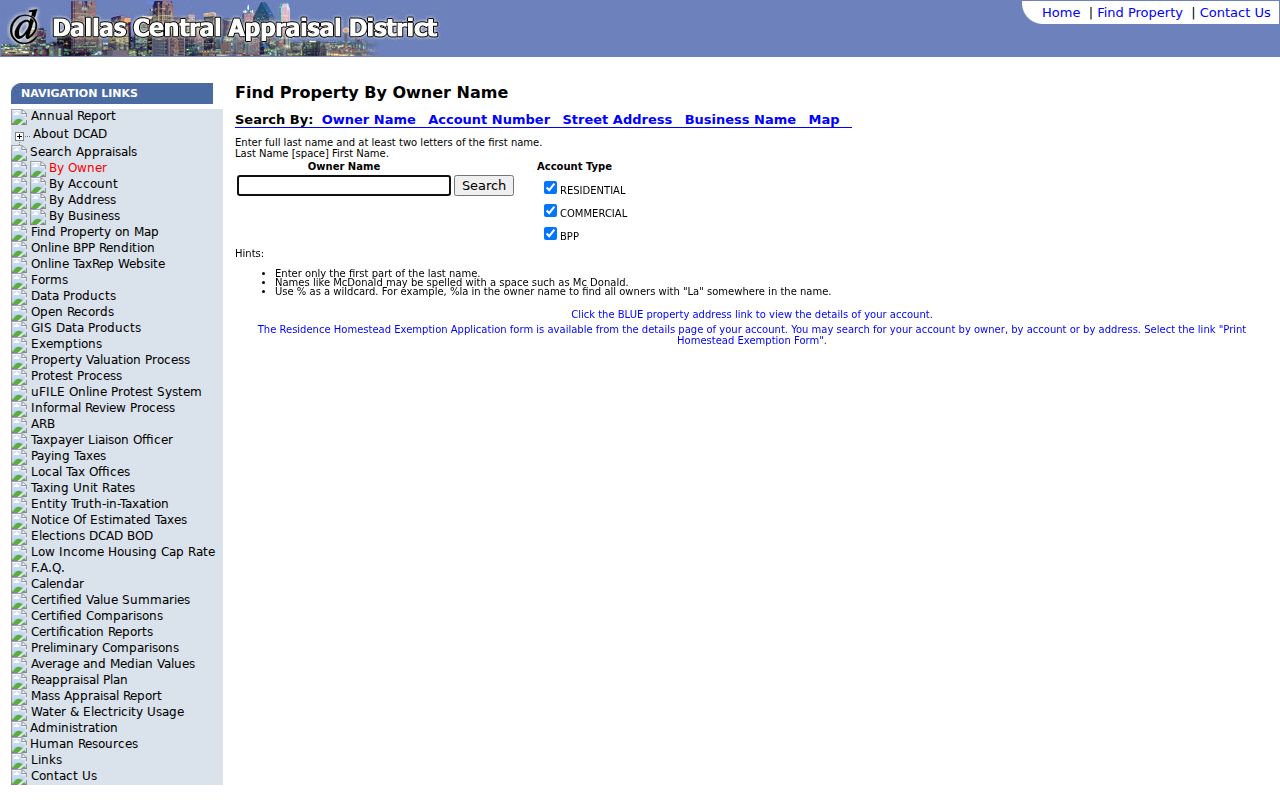
Write down the exact field labels from any Dallas result. That habit keeps an owner name, mailing address, and situs address from blurring into a claim the record never made.
Dallas Deed Index Paths
The Dallas County Clerk records deeds, liens, releases, and plats. Transfers, assumed names, military discharges, and other official records pass through the same office. In the property-records portal, Quick Search takes a grantor or grantee. It also accepts a subdivision, document type, or document number. Advanced Search adds a recorded-date range. It offers a choice of index only or index with full-text OCR. The public index is just a starting point. Images and electronic-certified copies move through the cart and payment flow.
The Recording Division handles roughly 400,000 recorded documents a year. For a Dallas address, pull the DCAD account's legal description first. Then search the owner as grantee to find the purchase record. The deed names the prior party. That party becomes the next grantee search over an earlier date range. The historical QuickLink collection covers deed index books from 1846 through 1963. That route sits apart from the modern portal. It does not mean every older deed image is online.
Dallas Voter Record Routes
The public Texas lookup is a registration-status tool. It is not a full voter file. It is not a record of ballot choices. It accepts a VUID, or a Texas driver-license number when one was supplied at registration. A name-based route also works, using first name, last name, date of birth, county, and location confirmation. A VUID or license route helps separate a common Dallas name. Registration generally closes 30 days before an election.
Texas Election Code sections 13.004 and 18.005 shield Social Security, driver-license, and related identifiers. Some voter-list fields carry public-access rules, and protected voters with confidential addresses have separate controls. Dallas County Elections answers local registration questions. For an individual's current status, the statewide form is the right place to check.
| Self-lookup | VUID, Texas license information, or name-based identity fields |
|---|---|
| County route | Dallas County Elections, 1520 Round Table Drive |
| Full-file route | SOS Form 24-1 affidavit and request process |
| Narrow search request | SOS Form 24-2, listed at $5 per statewide or county-specific search |
Dallas Court and Custody Checks
A Dallas court search is a case search, not a residential roll. The county record-search hub splits County Civil, Criminal, Probate, and District Court systems. The Dallas County and District Courts portal uses Smart Search along with party criteria, court location, and hearing controls. Its public landing page warns that data may be outdated. A blank result means the interface returned no case. It does not mean the person lacks court history.
A case may need a certified copy. It may fall outside web coverage. Then use the specific clerk and record series. Court files can be sealed or restricted, especially family and juvenile material. The Dallas County Jail Lookup offers separate name, booking-number, and case-number tabs.
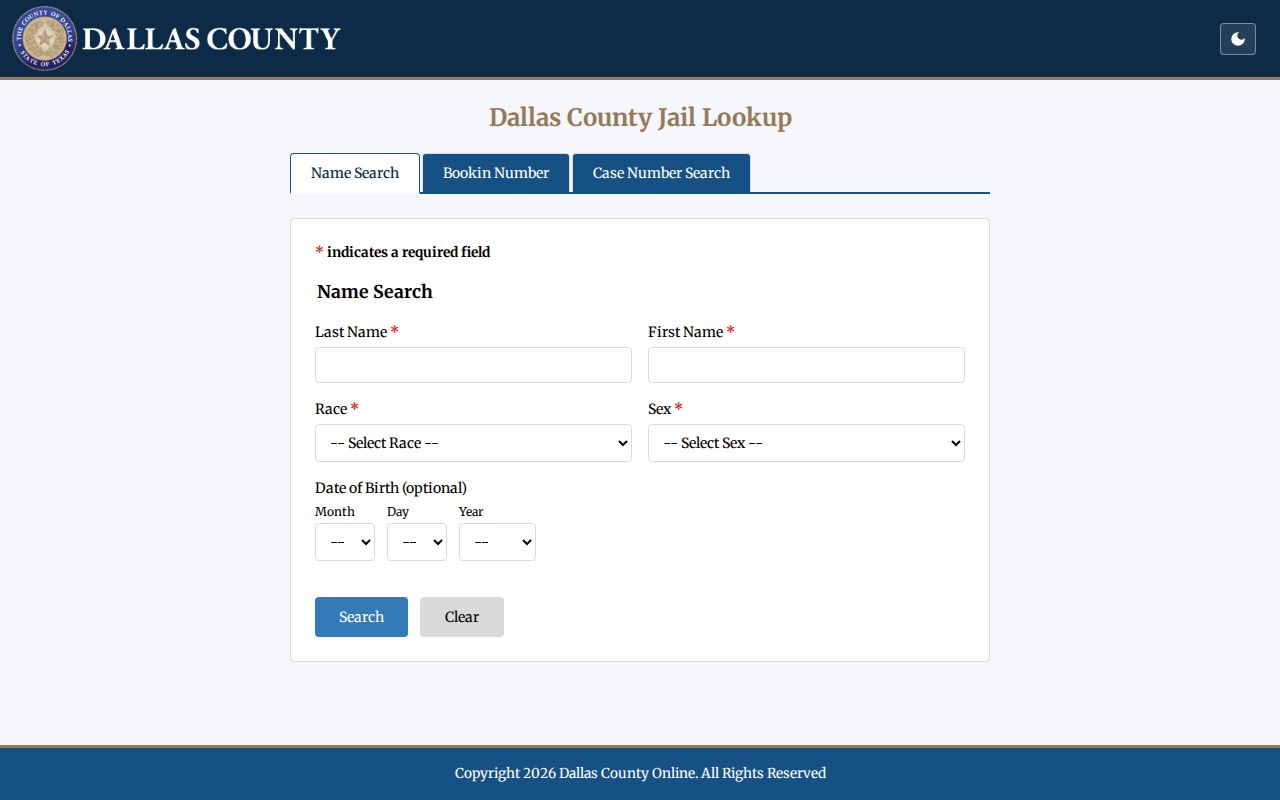
A booking snapshot shifts fast. It shows a moment in custody, not a conviction or a current home address. For someone held at the state level, the Texas Department of Criminal Justice offender search is the separate route.
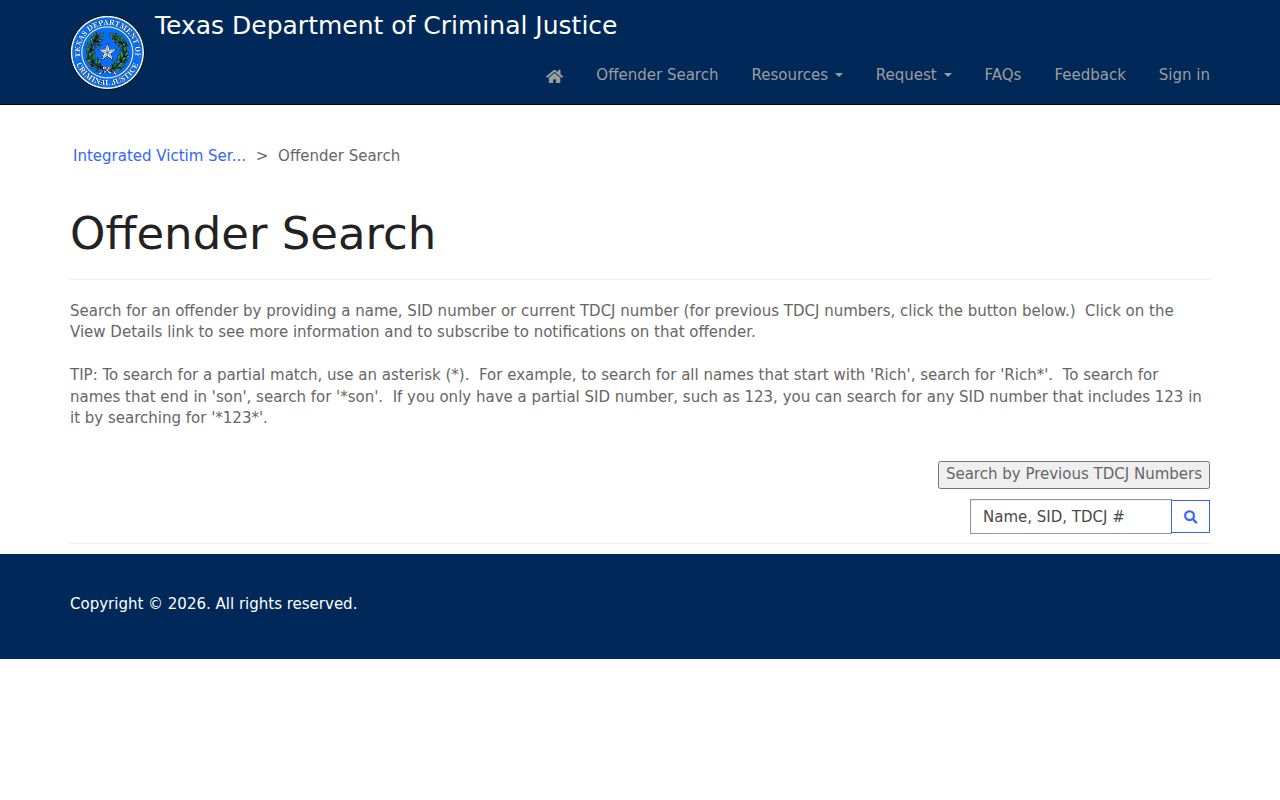
Read what that tool returns as a state custody record. It tracks status and release details. It was never meant to serve as a broad personal directory.
Dallas Vital Record Custodians
Where an event happened decides which office keeps the record. Inside city limits, qualifying events go through Dallas Office of Community Care Vital Statistics. Outside those limits, the County Clerk acts as local registrar for Dallas County births and deaths and also issues marriage records. Texas DSHS holds the state-level records. It supplies indexes, verifications, and eligible certified copies. The local city page splits long-form birth and death records from April 1983 forward from Texas abstract short-form birth records reaching back to 1926.
Texas Government Code section 552.115 opens birth records after 75 years and death records after 25 years, always subject to the access rules attached to the record. DSHS publishes birth indexes from 1925 forward and death indexes from 1965 forward, plus older microfiche that begins with 1903 material. An index line is not a certified copy. Eligibility, identification, and fee rules still govern every request.
Current Dallas Resident Directories
Directory-style sources in Dallas each answer a different question. DCAD links an owner or mailing label to a parcel. The voter route confirms registration status. The Clerk's index names parties to recorded documents. A city permit can list an applicant, contractor, architect, or owner, yet it still is not a resident list. To verify one person, compare at least two sources that answer different questions instead of treating any single search result as final.
| Dallas source | People or place connection | Custodian | Access route |
|---|---|---|---|
| DCAD appraisal account | Owner, parcel, address labels | DCAD | Free owner, address, account, business, and map searches |
| Voter status | Registration status and polling-place information | Texas SOS | Individual lookup; broader request forms have rules |
| Official Public Records | Grantors, grantees, and document parties | Dallas County Clerk | Public index; paid copy and certification routes |
| Permit and CO reports | Project parties and an address | Dallas Building Inspection | Online reports and city request route |
| Dallas library collections | Past households and community context | Dallas Public Library | Reading-room, microfilm, databases, and research scan routes |
The hunt narrows to one named person often. That is when the Dallas resident lookup route earns its keep, showing how the records can be checked against each other.
Dallas Record Source Comparison
Official Dallas and Texas sources state their custodian, record type, search fields, and access route. That clarity pays off. Check the label on any result. Ask the office for the underlying record when an online screen falls short. Commercial people-finding sites blend data from many dates and places, but none of that replaces the County Clerk's instrument, a DCAD parcel card, an SOS registration check, or a library directory page. Treat such a site as an unverified lead. Frankly, it is best skipped unless used only as a pointer.
| Source type | Best Dallas use | Important limit |
|---|---|---|
| Official custodian index | Check a named Dallas record and follow its request or copy route | Coverage, images, and confidential fields vary by record series |
| Library or archive collection | Place a past Dallas household, address, or civic event in time | Many volumes, files, and microfilm reels require a reading-room or research request |
| Commercial people-finding category | Generate a possible name or address lead for independent checking | May be outdated, blended, incomplete, or unable to identify the original custodian |
Some Dallas records simply are not online. The fallbacks are documented. Use the Clerk's document-request form, a court or probate contact, a city written request, a library desk, or an archival appointment. That recorded handoff beats guessing from a broad search result every time.
Dallas Record Privacy Boundaries
Texas public-record rules stop well short of full disclosure. The Address Confidentiality Program can issue a substitute mailing address for eligible participants. Protected-voter procedures can withhold a voter's details. Motor-vehicle personal information stays restricted under Texas Transportation Code Chapter 730 and federal law. Sealed court material, juvenile records, and some vital-record information carry their own limits, and an absent address may be protected rather than missing by mistake.
- Roll
- A list maintained for one purpose, such as appraisal or voter registration.
- Index
- A search aid that points to a record; it may not include the full document image.
- Parcel
- A defined piece of land tied to an appraisal account and legal description.
- Criss-cross directory
- An older directory arranged by address instead of by surname.
Personal, lawful research only. Dallas record searches must not be used to stalk, harass, intimidate, or harm anyone. Texas Penal Code sections 42.07 and 42.072 address harassment and stalking.
Dallas County Filing Alerts
Dallas County runs a free property-fraud alert. Subscribers get notice when a document matching their monitored information is filed. The alert is a prompt, not a shield. Reviewing the official record quickly is what it usefully triggers. It blocks nothing and never substitutes for tracing a title history. For a purported fraudulent conveyance, the county describes an affidavit and certified-mail process under Texas Government Code section 51.9035, then a waiting period and a possible district-court petition. Start through the Dallas County property-fraud page, never through an unsolicited notice. The county also warns about fake jail-bond, jury-duty, and warrant callers demanding gift cards, apps, cryptocurrency, or wire payments. Confirm any caller through a known government number.
Dallas Archive Name Leads
Dallas History & Archives at the J. Erik Jonsson Central Library keeps a wide mix of material. City directories sit here, along with telephone and criss-cross directories. Yearbooks, maps, and manuscripts are part of the holdings too. So are photographs, oral histories, and newspapers. The collection is deep. More than 60,000 books sit alongside roughly 1,500 print or microfilm newspaper and periodical titles. Dallas Morning News access runs from 1885 to 1984 through library-card or in-library options. Other routes include microfilm, the Portal to Texas History, and scans requested through texas@dallas.gov.
The Dallas Municipal Archives is a separate city resource. It keeps council minutes, maps, plans, photographs, microforms, and council-action files. Access comes by appointment. Name a record group and a date span when requesting time there. A school, church, neighborhood, street, or project often works better as a search key than a broad surname. Those local collections can reconnect family, classmate, or neighborhood history. They just cannot promise anyone a current address.
Historical Dallas Resident Directories
Printed directory research in Dallas reaches back to at least 1875. Local and state holdings include Butterfield and Rundlett, Morrison, Morrison and Fourmy, Evans and Worley, John F. Worley & Co., R. L. Polk, and the telephone-directory publishers. No single shelf holds everything. Dallas Public Library, the Texas State Library and Archives Commission, the Briscoe Center, FamilySearch, the Portal to Texas History, and the Dallas Historical Society each keep different pieces of the historical run.
A directory entry proves something concrete. It places a person, address, occupation line, or household in that volume. It cannot fill gaps between volumes or prove where anyone lives today. The fuller Dallas city directory collections route explains how to read the shelves, digital images, and reverse directories by year.
Dallas Courthouse Record Gaps
Fire shaped early recordkeeping here. Dallas County was founded in 1846. Its stone courthouse burned in 1880. The structure was rebuilt from the remains. The Texas State Library's Dallas guide lists what survived: civil papers from 1846 through 1938, civil minutes through 1939, and death and inquest records spanning 1889 to 1968. Researchers should also expect quirks. The guide flags a case-number restart in 1856 and transposed dates. Missing cases appear too. The District Clerk lost cases from 1921 through 1940.
An empty index is itself a clue. When a Dallas lookup stalls, try nearby years and variant spellings. Deed books, probate files, minutes, newspapers, and the correct Central Records route can also help. Recordkeeping about the missing series pays off. Naming the next custodian beats assuming a record is gone. That habit makes any search of Dallas County residents records far more reliable.