
Dallas Previous Residents by Era
Previous residents of a Dallas address leave different kinds of evidence in different periods. The strongest trail begins with the current parcel’s legal description, then moves through recorded deeds, historic index books, directory shelves, census images, maps, permits, and end-of-life records. Dallas sources do not all cover the same years or use the same access channel. The table separates ownership evidence from household clues, so a record is not asked to prove more than it can show.
| Source | Years It Covers | Where Held | What It Shows |
|---|---|---|---|
| Dallas County historical deed-index books | 1846-1963 | County Clerk QuickLink | Index lead to deed books or related material |
| Current official public-records search | Modern records, date-filtered | Dallas County Clerk | Grantor, grantee, document, subdivision, and OCR-index leads |
| Dallas city and criss-cross directories | 1875-1991, with gaps | Dallas Public Library and holding libraries | Historical household and address leads |
| Federal census images | Released under the 72-year rule | National Archives routes and library databases | Household detail near a directory year |
| Murphy & Bolanz and building material | Block books 1880-1920; permits vary | DPL and Dallas city channels | Lot, block, map, construction, or alteration context |
Use the date in hand to choose the first source. A recent transfer calls for the County Clerk and DCAD. A pre-1964 deed needs the historical index habit. A household question belongs with directories and census images, while an old structure may need maps, building-log material, or a permit request.
Dallas Address Records That Last
For Dallas previous residents research, start with the Dallas Central Appraisal District parcel card. DCAD is separate from the County Clerk and searches by owner name, account number, street address, business name, and map. An account detail can show an owner, mailing address, situs or property address, legal description, values, exemptions, and account history. Copy the account number and legal description before looking for a deed.
The situs address is the physical location assigned to the parcel. A mailing address is where the office sends notices. Those labels can differ, so a mailing line must not be treated as proof that an owner lived at the Dallas property. A homestead exemption is also an owner-occupancy clue, not conclusive evidence of a current occupant. Record the label and date exactly as the Dallas card presents them.
Dallas addresses can change in form across records. A parcel may split, recombine, replat, use a corner entrance, or appear only as a lot and block. The legal description and map context are usually steadier handoffs than a familiar street number. DCAD’s current map can also expose historic parcels for the prior five years, but its boundaries are approximate and not a survey.
Note: Keep the Dallas situs and mailing labels separate in the research log before drawing any conclusion about residence.
Trace Dallas Previous Residents by Deed
A Dallas deed chain follows recorded transfers backward from the current parcel relationship. Search the current owner as grantee in the County Clerk’s Official Public Records system, then read the purchase deed or index row for the prior grantor. Search that seller as a grantee in an earlier window and repeat. Compare the legal description, subdivision, lot, block, abstract, recorded date, and instrument number at every handoff. A deed identifies parties to a transaction; it does not by itself establish every person who lived at the address.
- Use the DCAD parcel card to record the account number, current owner of record, and legal description.
- Search the Dallas County Official Public Records portal by current grantee, legal description, subdivision, instrument number, or date.
- Open the purchase row and copy the grantor, grantee, document type, recorded date, instrument number, and legal description.
- Search the prior grantor as a grantee in an earlier period, then compare the property description before continuing.
- When the modern path ends, use the historical deed-index books, microfilm, Central Records, or a County Clerk document request.
- Grantor
- The party conveying an interest in a recorded deed.
- Grantee
- The party receiving the interest named in that deed.
- Chain of title
- A dated sequence of recorded transfers traced backward through the same parcel or legal description.
- Legal description
- The lot, block, subdivision, tract, or other formal land description that can outlast a changing street label.
On a Dallas title trail, place the Dallas account number beside the Dallas instrument number. A Dallas deed, Dallas parcel card, and Dallas map should be cited separately because they serve different functions. When the Dallas chain reaches older books, record the Dallas volume and Dallas page.
Dallas Deed Index Era Break
Dallas previous residents research changes method at the historical deed-index divide. The County Clerk’s QuickLink collection identifies Deed Record Index Books from 1846 through 1963. These books separate searching and viewing from purchasing, and an index hit is a lead to the deed book or microfilm rather than a substitute for reading the instrument. For early Dallas material, the Dallas Genealogical Society also has transcriptions of deed books A-E from 1846-1855 with a complete name index.
| Current route | Official Public Records quick and advanced search, with party, subdivision, document, date, index-only, and OCR options. |
|---|---|
| Historical route | QuickLink index books through 1963, then deed-book page, microfilm reel, Central Records, or a request route as needed. |
| Shared check | Compare the legal description, parties, instrument reference, and recorded date before joining two records. |
The Dallas County historical deed-index page shows the older collection’s search and access route. It is an important Dallas handoff when a modern query does not reach a prior conveyance.
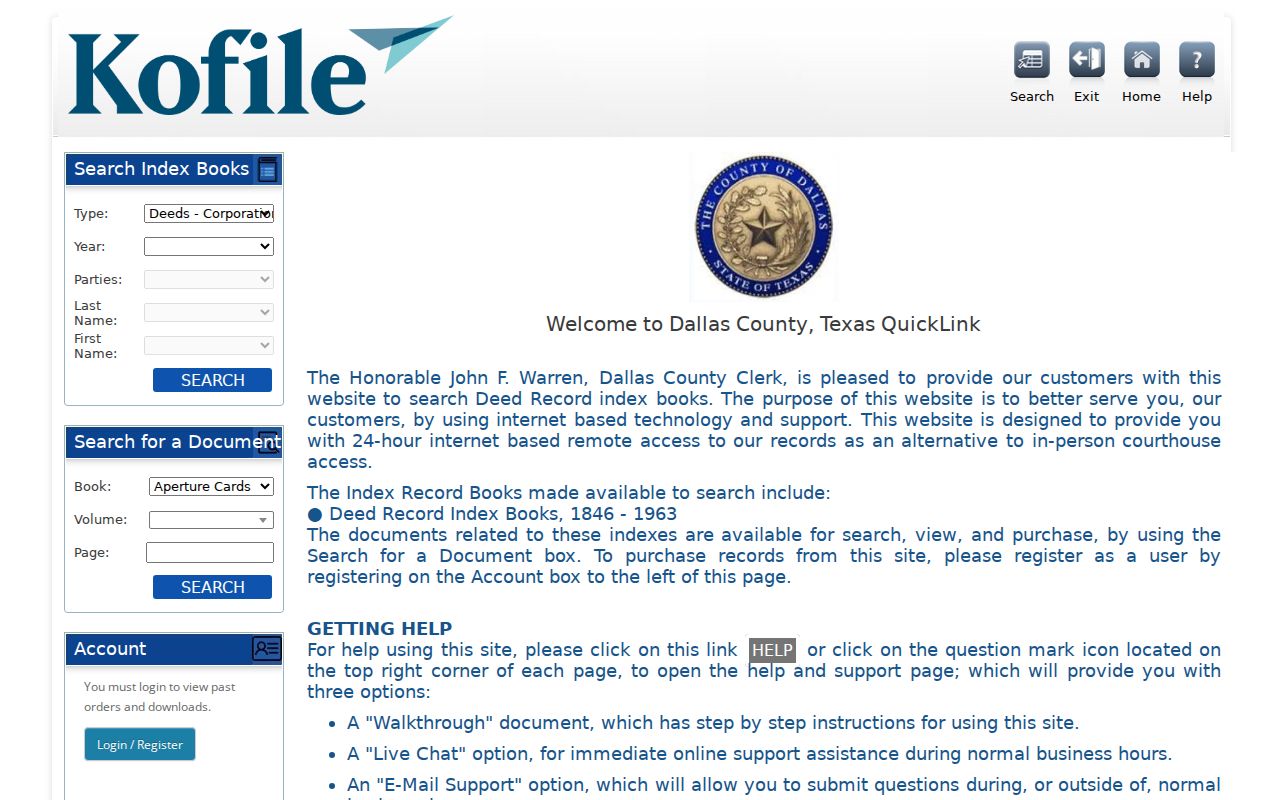
The Dallas image reinforces the difference between an index and a deed. Follow the row to the correct book or instrument, and preserve the source page so another researcher can repeat the trail.
Dallas Previous Residents in Directories
Past residents are not always past owners. Dallas city and criss-cross directories can connect a printed street number to a householder, while an alphabetical entry may add an occupation, spouse notation, or telephone context. Pair each directory year with the nearest released federal census rather than treating either source as complete. The historical collections themselves are described on the Dallas city directory page, where the publisher runs and entry-reading steps are kept together.
- Write down the directory publisher, year, page, printed name, street form, and section.
- Check the next earlier and later available Dallas volume for a move, spelling change, initial, or widow notation.
- Pair that directory year with the nearest released census image to test household members and birthplace details.
- Use the criss-cross section to check the address direction, then compare deeds or a legal description if the number seems different.
- Confirm a key identity with a newspaper, obituary, probate record, church register, yearbook, or map before treating it as the same household.
Dallas Public Library holds city, telephone, and criss-cross directories, along with maps and newspapers. The census release rule means a recent household will not appear in the newest schedules, so the directory shelf and record custodian remain important access channels.
Dallas House History Clues
Deeds do not date every physical change to a Dallas house. Sanborn maps can show a footprint or use, Murphy & Bolanz block and addition books can connect an older lot and block, and a permit or city building log can identify an alteration. Dallas Building Inspection provides online permit-number or address searching, Certificate of Occupancy reports, and annual permit reports. Older plans and site-plan requests use the city’s written Open Records process, not a general counter-copy service.
Dallas’s 2025 library discussion described Recollect digitization of a city building-permit log book covering 1905 through the 1970s. That is a promising physical-history lead, but it does not mean every log page or index is online. Preservation Dallas directs house researchers to its Resource Center and to DPL directories, Sanborn maps, newspapers, and building-permit log books.
For a Dallas address that seems to vanish, compare the lot and block, adjacent streets, map sheet, permit project, and deed legal description. Do not publish a year-specific renumbering claim: the gathered Dallas sources did not verify a general street-renumbering schedule.
Note: A permit names an applicant or contractor for a project and does not prove that person was a Dallas resident.
Dallas Probate and Obituary Endpoints
A chain can end with an estate, heir, business, or former legal description instead of a familiar person. Dallas County probate records cover wills, intestate heir proceedings, guardianships, and other matters. The Dallas Courts Portal supports available cause-number or first-and-last-name searches. For Dallas County probate files, the clerk lists dcclosedprobaterec@dallascounty.org for pre-2013 records and dcopenprobaterec@dallascounty.org for 2013-current records; include the case number and style when requesting a record.
Dallas newspapers and obituaries can add a spouse, relatives, address, funeral home, church, or move. They remain reported sources, so compare a key statement against probate or a deed. FamilySearch also lists Dallas County Oakland Cemetery Interment Cards from 1891-1999, although access and image availability vary by collection and login or location.
Dallas County Central Records holds historical books, microfilm, and closed material across series. When an online result fails, a precise request to the correct Dallas custodian is better than filling a title gap with an assumed owner.
Dallas Records After the 1880 Fire
Dallas County’s record story helps explain why house history requires several repositories. The county was created in 1846. Its stone courthouse was destroyed by fire in 1880, then rebuilt from the charred remains. Later series also have documented gaps: the Texas State Library Dallas guide notes a civil case-number restart in 1856, date transpositions, missing cases, and a major 1921-1940 District Clerk loss with surviving reels for some files.
Those facts are not evidence that a particular owner or resident was absent. They are practical warning signs to try alternate spellings, neighboring years, deeds, newspapers, probate, minutes, maps, and microfilm. Dallas historical research is not a straight path from old paper to one portal.
Dallas Previous Residents, Used Lawfully
Dallas previous residents research is most useful for house history, family history, estate questions, and civic curiosity. Keep a dated source log and separate an owner of record from a confirmed household member. Protected voter records and address-confidentiality participants may not appear with ordinary address details, and a record’s absence can be a privacy limit rather than a negative finding.
Lawful use. Use Dallas house-history records with care. Do not use information from an old address trail to stalk, harass, or harm any person.
Dallas County’s property-fraud alert is another current tool with a narrow purpose. It sends a notice when a matching document is filed, but it does not stop a fraudulent document from being filed and it is not historical title evidence. Verify a serious title issue with the County Clerk and the appropriate professional or official custodian.