
Trace a Dallas Street by Address
Start the Dallas street directory trail with a complete address, including the number, direction, street name, suffix, unit, city, and ZIP when known. The first result is not a roster of occupants. It is a parcel lead. Dallas Central Appraisal District, usually called DCAD, ties that address to an account, an owner of record, a legal description, and labeled situs and mailing addresses. Keep the labels and the date checked, because a mailing address can point somewhere other than the property.
- Run the number and street through DCAD Address Search. Save the account number, property link, situs address, owner field, and legal description exactly as shown.
- Open the same account in DCAD Property Map. Identify the parcel and adjoining lots, recording each separate account rather than assuming one pin equals one parcel.
- Use the current owner or legal description in the Dallas County Clerk index. The purchase deed supplies a grantor, grantee, instrument number, recorded date, and transaction context.
- For a known person, use the Texas voter-registration route only within its lawful individual-check purpose. It is not a public button for making a street-wide list.
- For an older household, check Dallas Public Library city, telephone, and criss-cross directories. Match any address hit with a deed, newspaper, permit, census, or other dated record.
Each handoff answers a different question. DCAD places the land, the Clerk documents a recorded transaction, the voter route checks registration status for an identified person, and a criss-cross volume gives a historical address-to-householder lead. A Dallas street directory result is strongest when those roles remain separate.
Dallas Street Directory Address Fields
DCAD offers owner, account, street-address, business-name, and map tabs. For a Dallas by-address search, the address form accepts Number, Direction, Street Name, Building, Suite, City, Number From, Number To, and Account Type. Street Name needs at least two characters and no spaces. The form advises omitting the street type when prompted, permits a single number or a range, and supports the percent sign as a wildcard. A one-letter street search uses X%.
| DCAD address field | Entry rule | Street-directory purpose |
|---|---|---|
| Number | Numeric only, without suite letters | Starts one parcel lookup |
| Direction | Choose from the portal dropdown when applicable | Separates directional street variants |
| Street Name | At least two characters, no spaces; % supported | Finds a street segment or range |
| Building / Suite | Optional unit details | Keeps a unit distinct from the street name |
| City | Optional portal dropdown | Helps narrow a Dallas-area match |
| Number From / To | One number or both ends of a range | Reviews several addresses along a street |
| Account Type | Residential, Commercial, or BPP | Limits the account category |
The DCAD Address Search shows the form used for a Dallas street directory query.
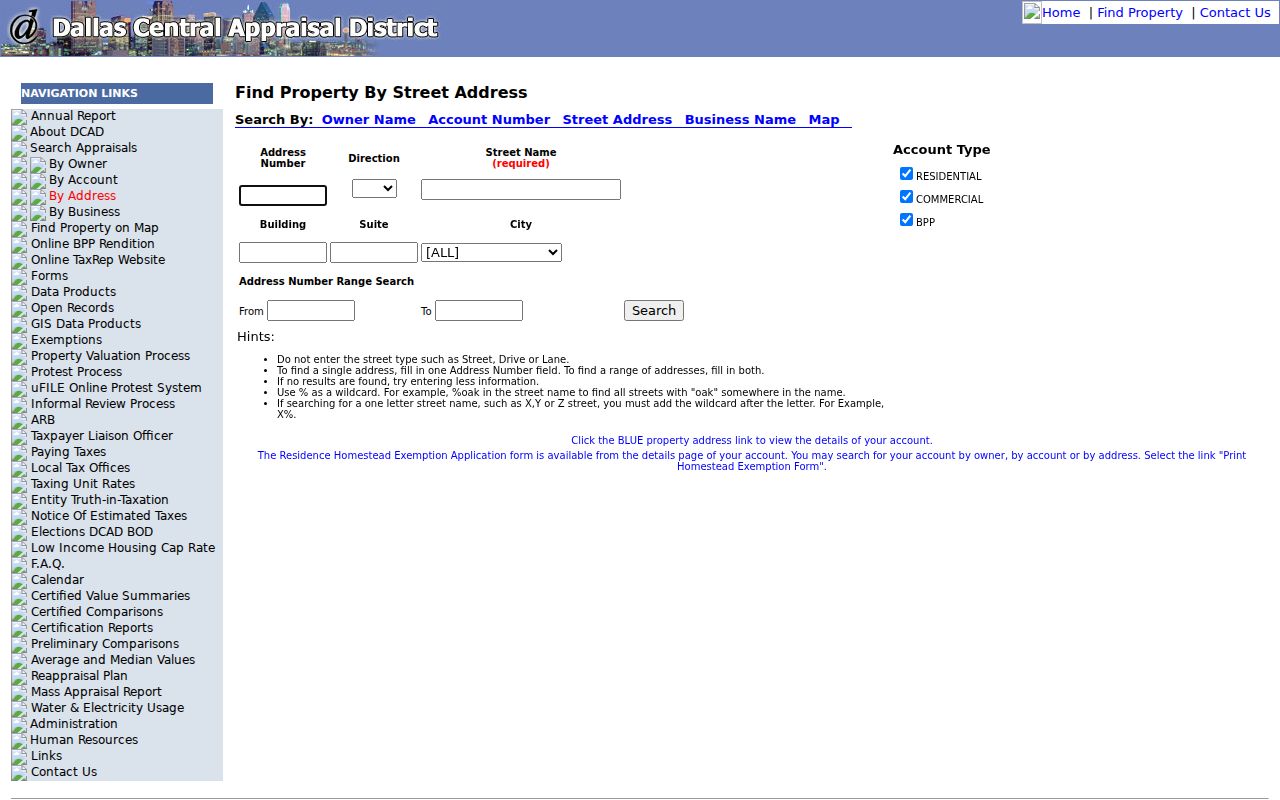
Its result rows list property address, city, owner or business name, total value, and type. Open the blue property-address link before drawing any conclusion, because the detail record carries the account and address labels needed to check the next source.
Map Dallas Street Parcels
DCAD Property Map lets an address search move from a typed address to the shape and setting of the parcel. It searches a 17-digit account, property address, owner name entered as “Last First” without a comma, or the first part of a DBA. Select the target, then use Parcel Identify Current Year and the popup’s Next control when more than one account appears at a mapped location. A map pin can represent more than one account, especially where lots or improvements are complex.
Current parcels, prior five years of parcels, neighborhoods, MAPSCO grid, Dallas block, abstracts, subdivisions, and district layers are available. Only one identify layer may be active at a time, even when other layers are visible. Use the map as a locational tool, not a survey. DCAD says its contemporary boundaries are approximate and reflect changes since certification; a certified GIS product and a deed legal description are better evidence for a boundary dispute.
The DCAD Property Map is the source for this Dallas parcel-map step.
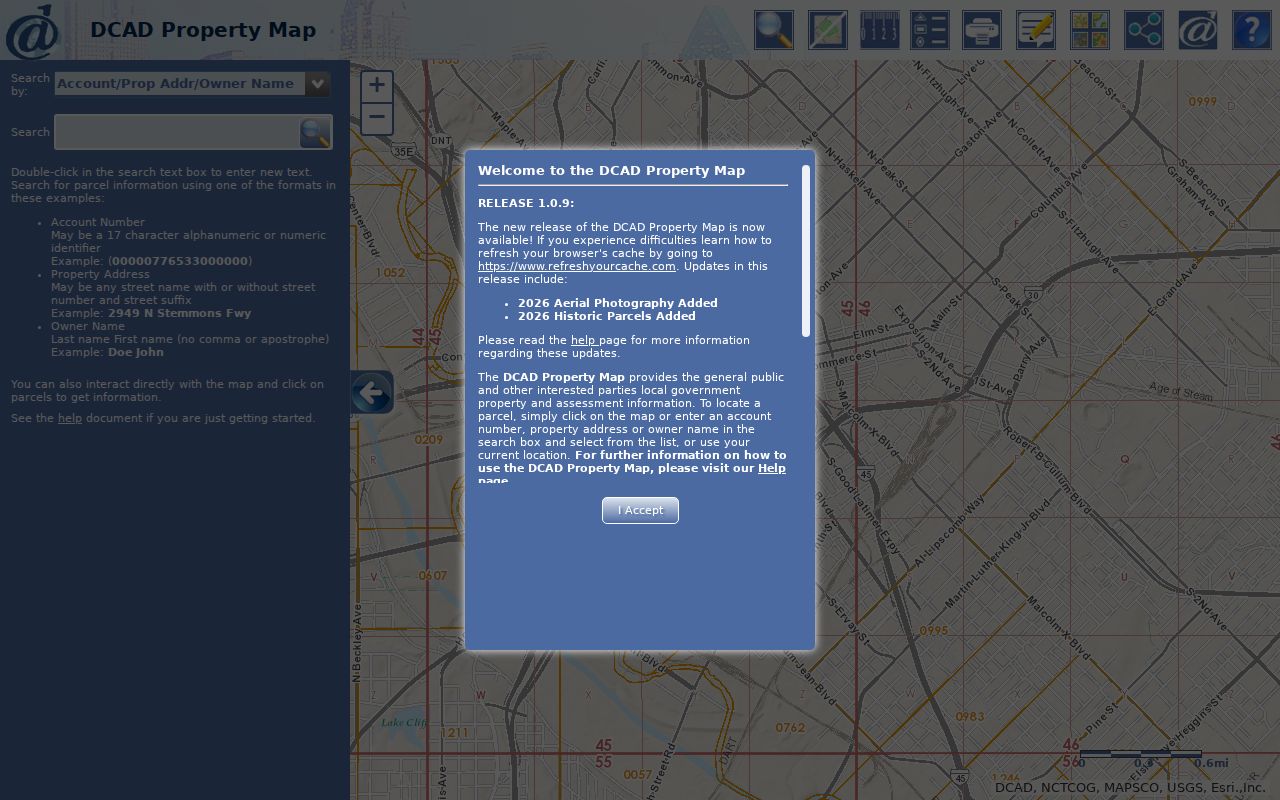
Use the map controls to note the account and legal description, then open each adjacent account separately. The result provides a repeatable way to describe a street edge without claiming that every person present at an address appears in public records.
Dallas Street Directory Record Coverage
Address-keyed sources around Dallas County do not provide the same kind of proof. Property and tax records identify an owner of record and a location. Recorded instruments document transfers and related filings. City permit data can date work at an address. Historical directories point to a past householder. Combining them produces a dated trail, while treating one row as a current household list does not.
| Address-keyed source | Dallas custodian | Street or block evidence | Access route |
|---|---|---|---|
| Appraisal account | DCAD | Owner, situs and mailing labels, values, exemptions, legal description | Free owner, address, account, business, or map search |
| Parcel geometry | DCAD Property Map | Parcel shape, adjacent lots, account link, current and prior map context | Free map viewer; boundaries approximate |
| Recorded deed or index | Dallas County Clerk | Grantor, grantee, instrument, legal description, recorded date, document type | Current Public Search; historical index books through 1963; cart or request for copies |
| Plat or subdivision record | County Clerk and DCAD | Lot, block, subdivision, tract, and parcel relationship | Legal-description and official-records search; image access varies |
| Tax account | Dallas County Tax Office | Certified owner, property location, current-year and total amounts due | Online property-tax lookup |
| Permit or certificate | Dallas Building Inspection | Project, address, applicant or contractor, permit, certificate | Online records, DallasNow, and older-file public-information request |
| Historical criss-cross directory | Dallas Public Library / TSLAC | Past address-to-occupant or householder lead | Reading room, microfilm, and selected digitized holdings |
Dallas County tax amounts, an exemption flag, and a mailing field are contextual data. They do not prove occupancy. Preserve the source, record date, account, and exact field label before comparing a property card with a deed or old directory.
Follow Dallas Street Deed Chains
After DCAD supplies a current owner and legal description, search the Dallas County Official Public Records portal for that owner as grantee, the subdivision, document type, document number, date, or indexed full text. The purchase deed or index row can identify the seller, recorded date, instrument number, and legal description. Then search the prior seller as a grantee in an earlier period. Compare lot, block, abstract, tract, subdivision, and address at every turn.
A release of lien may confirm a loan event but is not a transfer. A plat explains the lot but does not name every household member. If the modern path ends, the County Clerk’s historical Deed Record Index Books cover 1846 through 1963. Search and viewing differ from purchasing there, and an older index hit remains a lead to the book or microfilm rather than a replacement for the instrument.
The official records search is the modern index interface for the Dallas street directory deed step.
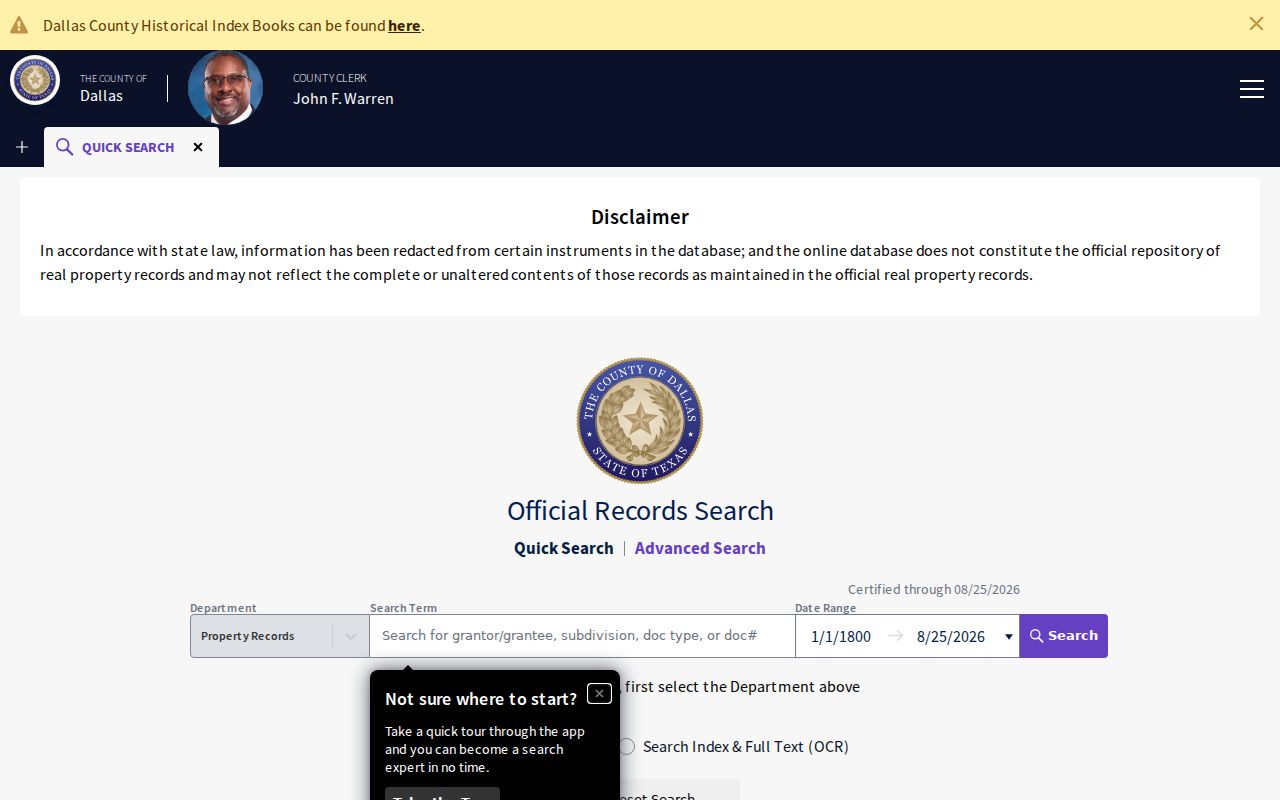
Quick Search accepts grantor or grantee, subdivision, document type, and document number. Advanced Search adds recorded-date ranges and index-only or index-and-OCR choices, while images and e-certified records use the cart and payment flow.
Dallas Street Records by Numbers
Dallas County’s Recording Division describes roughly 400,000 recorded documents a year. That volume explains why a broad owner or street query can produce several plausible filings. An instrument number, recorded date, and legal description give each deed-chain note a firm point of return. They are more useful than a broad name match when several Dallas parcels, people, or documents share similar terms.
Time is another important number in the local chain. The current Official Public Records portal supports modern index and OCR work, while the County Clerk’s historical deed-index books cover 1846 through 1963. Dallas Genealogical Society transcriptions reach early deed books A through E for 1846 through 1855. Each range is a different access mode, so save the portal, book, volume, image, or request route beside the result.
Those figures do not make a result self-proving. They show why a narrow Dallas street search should retain the account, instrument, legal description, and source date before moving to the next record.
Dallas Address Permit Leads
A permit is an address event, not a resident list. Dallas Building Inspection provides online searches by permit number or address, monthly certificate-of-occupancy reports, and permit reports by year. The current city route includes DallasNow for permitting, planning, platting, inspections, and engineering. A result may name an applicant, contractor, owner, architect, or project address, so its role is to date or explain property work rather than establish who lived there.
For older plans or a site-plan request, use the City of Dallas written public-information process. The research notes that Central Files does not provide general counter copying or printing. Code complaints follow 311 and geographic district offices; the collected sources did not identify a general public code-case search. A careful address-research note should say which route was checked and what kind of evidence it returned.
Note: DallasNow is the current cloud platform, while older permit material can require a written request and a specific department or date span.
Dallas Street Voter Evidence
Texas provides an individual registration lookup through Texas Voter Information. The route may use a VUID, Texas driver-license information supplied at registration, or name details. It returns registration status and polling-place information when a match is found. It is not designed as a street-wide resident list, and it does not reveal ballot choices.
The more expansive voter-data request uses SOS Form 24-1, an affidavit-based public-information request with filters and fees. The data layout can include permanent and mailing address fields, precinct, status, and participation codes. Texas Election Code sections 13.004 and 18.005 protect Social Security, driver-license, DPS ID, and related identifiers. Protected voters and Address Confidentiality Program participants may have ordinary address details suppressed.
Use the narrowest lawful route. Registration or a public address field can support a dated research lead, but it does not prove that every person in a household is present or that a property owner is the voter.
Dallas Street Directory Terms
Several record labels need to stay distinct when a Dallas address search moves between offices. Recording the term as the custodian uses it prevents a mailing field, a parcel number, or a map outline from being given more weight than it has.
- Situs address
- The physical location assigned to a parcel.
- Mailing address
- The address used for notices. It can differ from the situs address.
- Parcel
- A mapped tax or account unit. One street number can involve more than one account.
- Plat
- Recorded map or subdivision material connecting lots, blocks, streets, and tracts.
- Criss-cross directory
- A historical directory arranged from street and number to an occupant or householder lead.
The legal description and account number are the stable handoffs in a Dallas address trail. A street label, entrance location, or unit pattern can change, especially at corners, after replats, or when a building has several accounts.
Dallas Street Numbers Can Drift
Older Dallas neighborhoods, annexed areas, corners, alleys, and subdivisions can create an address mismatch between a current parcel card and a historic record. The research did not locate a verified citywide renumbering or renaming schedule with years. That absence matters: a year-specific renumbering claim should not be inferred from one failed address query.
Instead, bridge the gap through the lot and block, abstract, subdivision, deed legal description, Sanborn map, permit, and adjacent street names. A corner account may use the entrance address instead of the longer frontage. If the chain seems to jump, check plats, probate, releases, tax records, and the County Clerk’s Central Records holdings before assuming an owner or occupant.
For modern map changes, DCAD provides current and prior five-year parcel layers. That local map history can explain a parcel configuration, but a legal description and recorded instrument remain firmer evidence.
Dallas Street History by Number
Dallas Public Library’s History & Archives holdings include city, telephone, and criss-cross directories, as well as newspapers, maps, yearbooks, manuscripts, and photographs. In a criss-cross volume, begin with the street as printed, test direction and suffix variants, compare nearby numbers, and read the publisher’s own abbreviation key. Pair any address hit with a deed, permit, census, obituary, or newspaper before naming a household.
The library’s directory shelf is the historical counterpart to a modern by-address search, not a substitute for present ownership data. The historical collections are discussed in more depth in the Dallas city directory collections, where the years, publishers, and reading-room routes matter most.
Keep the printed street form, volume or collection, page, and date beside each historical address lead. Those details make it possible to return to the right shelf or image when a later source disagrees.
Dallas Street Privacy Boundaries
A street-level record search cannot reveal everyone who occupies a property. DCAD can show an owner and record-labeled addresses, but a mailing address is not proof of residence. Historical directories are dated leads. Voter information has confidentiality rules. Sealed records, protected voter records, and Address Confidentiality Program information may be missing by design, not because a search failed.
The Texas Address Confidentiality Program provides qualifying participants a substitute mailing address and mail forwarding. If an ordinary address is withheld, do not try to reconstruct or circulate it from fragments. Protect sensitive identifiers, cite the custodian and date, and ask the originating office to correct a public record when an official field appears wrong.
Lawful use. Dallas street and parcel records support personal, family-history, property, and civic research. Do not use address information to stalk, harass, intimidate, or harm another person.