
Finding Dallas Resident Records
Dallas has no single public roll of everyone who lives in the city. A useful search begins with the kind of fact already known. A street address can lead to the Dallas Central Appraisal District, known as DCAD, where a parcel card labels both the property address and its owner. A name can be checked against the Texas voter-status tool, a court party index, or an older directory. Each source answers a narrower question. The County Clerk deed index identifies parties to recorded transactions, while a directory can place a household at an address in a particular year.
Keep the result, the date, and the office together in your notes. A DCAD mailing address may differ from the situs address, which is the location of the land. A court hit may identify a party, not a current resident. For an old home, the Dallas Public Library directories, newspapers, maps, and local-history files can supply the time layer that a current parcel card cannot.
- Search DCAD by owner name or street address and save the account number, property address, legal description, and each address label.
- Use the Texas voter-information lookup for a registration-status check when its identity fields fit the person.
- Search Dallas County Official Public Records by grantor, grantee, subdivision, document type, or document number.
- For a past household, ask Dallas History & Archives for the relevant directory, newspaper, yearbook, or map collection.
- When a needed city record is not online, send a specific written request through the City Secretary or the responsible Dallas department under the Texas Public Information Act.
Dallas Resident Records Offices
Dallas searches often cross city, county, and state lines of custody. The Recording Division keeps deeds and related official records. DCAD keeps appraisal-account data and parcel mapping. The Secretary of State provides the public voter-status route, while Dallas County Elections handles county registration questions. The city keeps permits, municipal citations, archives, and city-limit vital records. Use the office that created the record, because a city request does not retrieve a County Clerk file.
Dallas County Clerk Recording
500 Elm Street, Suite 2100
Dallas, TX 75202
214-653-7099
Dallas Central Appraisal District
Property and parcel accounts
Separate from the County Clerk
Use the DCAD contact route
Note: County pages have reported building-repair changes, so call before an in-person Dallas records visit.
Dallas Property Roll Fields
DCAD is the first address-based stop for many Dallas resident searches. Its owner screen has Last Name and First Name fields, plus Residential, Commercial, and BPP account-type choices. The address screen separates number, direction, street name, building, suite, city, range, and account type. A property result can list the account number, owner, mailing address, situs address, legal description, values, exemptions, and taxing jurisdictions. An exemption can be a useful clue, but it does not prove someone is there today.
| DCAD field | Format | Why it matters |
|---|---|---|
| Owner last name | Required, two or more characters | Searches an owner-name account record |
| Street name | Two or more characters, no spaces | Starts an address search |
| Number from and to | Numeric range | Checks a span on a Dallas street |
| Account number | Exactly 17 letters or numbers | Opens one appraisal account |
The DCAD owner search shows the separate paths available before a parcel is opened.
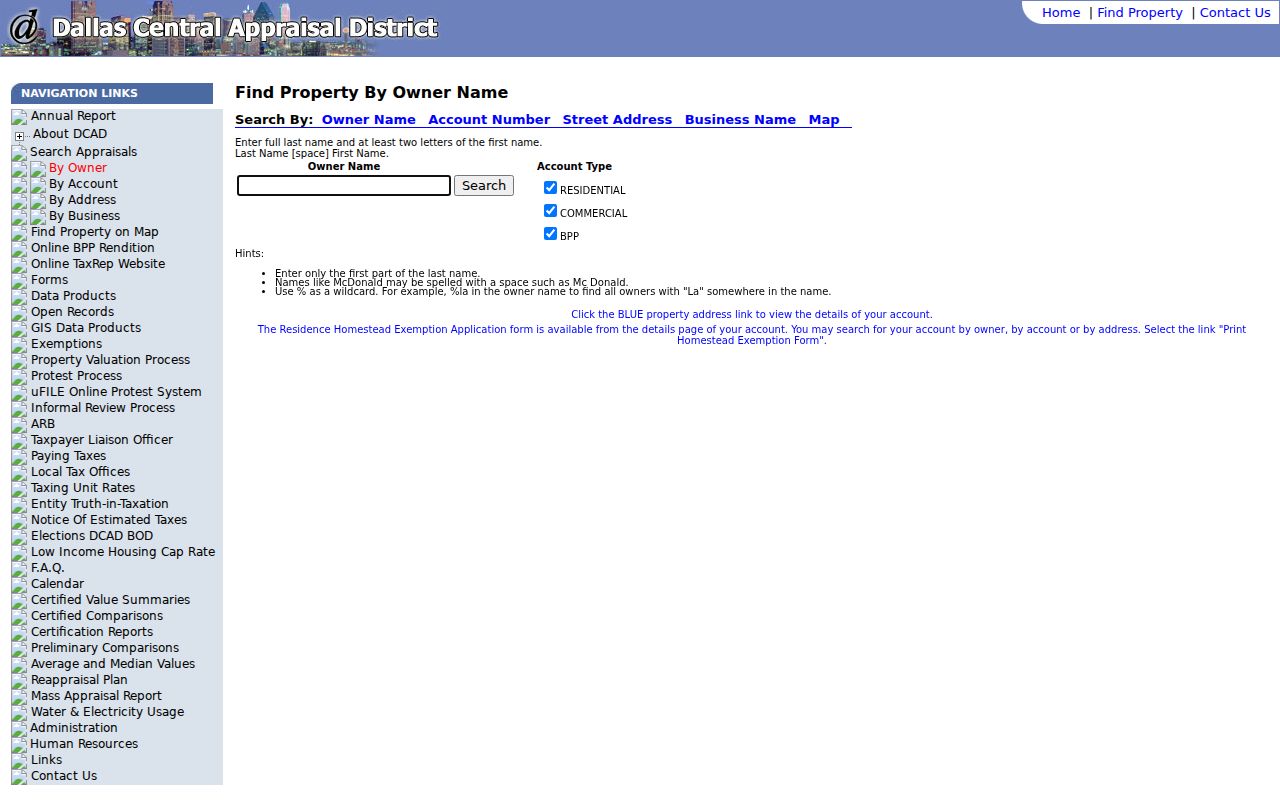
Record the exact field labels from a Dallas result. That keeps an owner name, mailing address, and situs address from being blended into a claim the record never makes.
Dallas Deed Index Paths
The Dallas County Clerk records deeds, liens, releases, plats, transfers, assumed names, military discharges, and related official records. In the current property-records portal, Quick Search accepts a grantor or grantee, subdivision, document type, or document number. Advanced Search adds a recorded-date range and a choice between the index alone or index plus full-text OCR. The public index is a starting point. Images and electronic-certified copies go through the cart and payment flow.
The Recording Division describes roughly 400,000 recorded documents a year. For a Dallas address, start with the DCAD account’s legal description, then search the owner as a grantee to find the purchase record. The deed names the prior party, who becomes the next grantee search in an earlier date range. The historical QuickLink collection covers deed index books from 1846 through 1963. It is a different route from the modern portal, not proof that every older deed image is online.
Dallas Voter Record Routes
The public Texas lookup is a registration-status tool, not a full voter file or a record of ballot choices. It can use a VUID, a Texas driver-license number when one was supplied at registration, or a name-based route with first name, last name, date of birth, county, and location confirmation. A VUID or license route can help separate a common Dallas name. Registration generally closes 30 days before an election.
Texas Election Code sections 13.004 and 18.005 protect Social Security, driver-license, and related identifiers. Some voter-list fields have public-access rules, while protected voters and confidential addresses have separate controls. Dallas County Elections can answer local registration questions; the statewide form is the correct place to check an individual’s current registration status.
| Self-lookup | VUID, Texas license information, or name-based identity fields |
|---|---|
| County route | Dallas County Elections, 1520 Round Table Drive |
| Full-file route | SOS Form 24-1 affidavit and request process |
| Narrow search request | SOS Form 24-2, listed at $5 per statewide or county-specific search |
Dallas Court and Custody Checks
A Dallas court search is a case search, not a residential roll. The county record-search hub separates County Civil, Criminal, Probate, and District Court systems, and the Dallas County and District Courts portal uses Smart Search, party criteria, court location, and hearing controls. Its public landing page cautions that data may be outdated. A blank result means the interface did not produce a case, not that the person has no court history.
Use the specific clerk and record series when a case needs a certified copy or is outside web coverage. Court files can be sealed or limited, especially family and juvenile material.
The Dallas County Jail Lookup has separate name, booking-number, and case-number tabs.
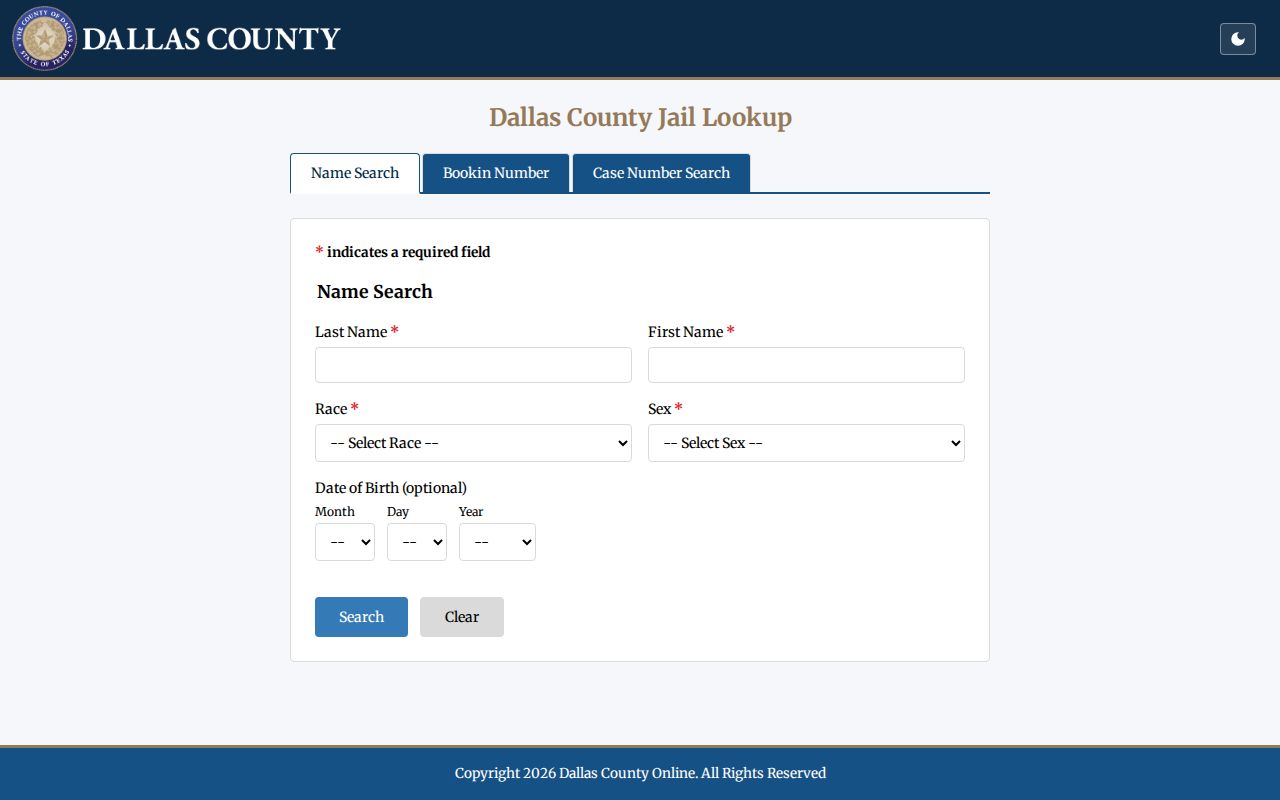
A booking record can change quickly and does not establish guilt or a current home address.
The Texas Department of Criminal Justice offender search is a separate state-custody route.
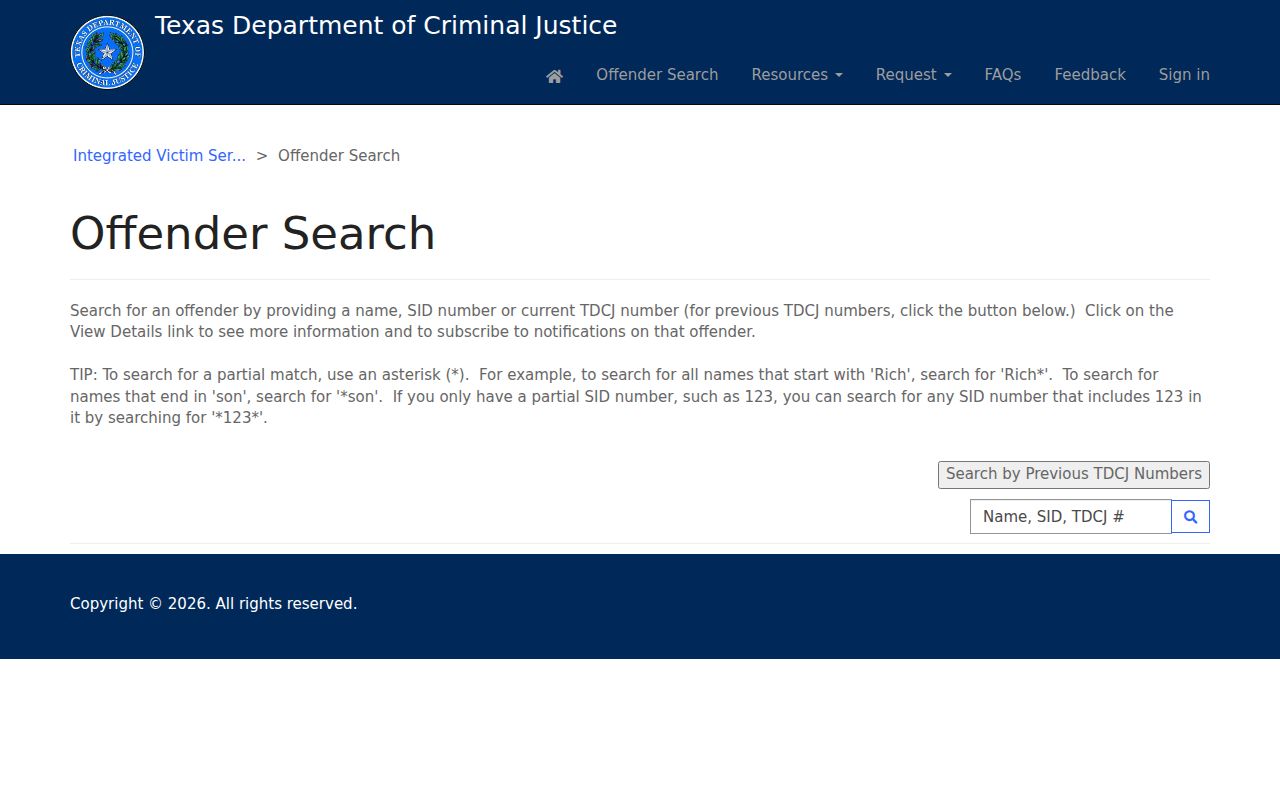
Its status and release information must be read as the state’s custody record, not as a broad personal directory.
Dallas Vital Record Custodians
Vital-record custody depends on where the event occurred. Dallas Office of Community Care Vital Statistics handles qualifying events within city limits. The County Clerk is the local registrar for Dallas County births and deaths outside city limits and issues marriage records. Texas DSHS supplies state records, indexes, verifications, and eligible certified copies. The local city page distinguishes long-form birth and death records from April 1983 forward and Texas abstract short-form birth records from 1926 forward.
Texas Government Code section 552.115 makes birth records public after 75 years and death records public after 25 years, subject to the access rules for the record. DSHS offers birth indexes from 1925 forward and death indexes from 1965 forward, with older microfiche beginning with 1903 material. An index entry is not a certified copy, and eligibility, identification, and fee rules still apply.
Current Dallas Resident Directories
Dallas directory-like sources organize different relationships to a place. DCAD ties an owner or mailing label to a parcel. The voter route checks registration status. The Clerk’s index identifies parties to recorded documents. A city permit can name an applicant, contractor, architect, or owner, but it is not a resident list. For a one-person verification, compare at least two sources that answer different questions rather than treating one search result as final.
| Dallas source | People or place connection | Custodian | Access route |
|---|---|---|---|
| DCAD appraisal account | Owner, parcel, address labels | DCAD | Free owner, address, account, business, and map searches |
| Voter status | Registration status and polling-place information | Texas SOS | Individual lookup; broader request forms have rules |
| Official Public Records | Grantors, grantees, and document parties | Dallas County Clerk | Public index; paid copy and certification routes |
| Permit and CO reports | Project parties and an address | Dallas Building Inspection | Online reports and city request route |
| Dallas library collections | Past households and community context | Dallas Public Library | Reading-room, microfilm, databases, and research scan routes |
When the search goal is one named person, the Dallas resident lookup route explains how the records can be checked against each other.
Dallas Record Source Comparison
Official Dallas and Texas sources identify the custodian, record type, search fields, and access route. That makes it possible to check the label on a result and ask the office for the underlying record when an online screen is incomplete. A commercial people-finding category may combine data from many dates and sources, but it cannot replace the County Clerk’s instrument, a DCAD parcel card, an SOS registration check, or a library directory page. Treat it as an unverified lead, if it is used at all.
| Source type | Best Dallas use | Important limit |
|---|---|---|
| Official custodian index | Check a named Dallas record and follow its request or copy route | Coverage, images, and confidential fields vary by record series |
| Library or archive collection | Place a past Dallas household, address, or civic event in time | Many volumes, files, and microfilm reels require a reading-room or research request |
| Commercial people-finding category | Generate a possible name or address lead for independent checking | May be outdated, blended, incomplete, or unable to identify the original custodian |
For a Dallas record that is not visible online, use the documented fallback: the Clerk’s document-request form, a court or probate contact, a city written request, a library desk, or an archival appointment. That recorded handoff is more useful than guessing from a broad search result.
Dallas Record Privacy Boundaries
Texas public-record rules do not make every field public. The Address Confidentiality Program can issue a substitute mailing address for eligible participants. Protected-voter procedures can withhold a voter’s details. Motor-vehicle personal information is restricted by Texas Transportation Code Chapter 730 and federal law. Sealed court material, juvenile records, and some vital-record information also have their own limits. An absent address may be protected, not missing by mistake.
- Roll
- A list maintained for one purpose, such as appraisal or voter registration.
- Index
- A search aid that points to a record; it may not include the full document image.
- Parcel
- A defined piece of land tied to an appraisal account and legal description.
- Criss-cross directory
- An older directory arranged by address instead of by surname.
Personal, lawful research only. Dallas record searches must not be used to stalk, harass, intimidate, or harm anyone. Texas Penal Code sections 42.07 and 42.072 address harassment and stalking.
Dallas County Filing Alerts
Dallas County offers a free property-fraud alert that sends notice when a document matching a subscriber’s monitored information is filed. It is a useful prompt to review the official record quickly. It does not block a filing and it is not a substitute for tracing a title history. The county describes an affidavit and certified-mail process under Texas Government Code section 51.9035, followed by a waiting period and possible district-court petition for a purported fraudulent conveyance.
Use the Dallas County property-fraud page, not an unsolicited notice, to start. Dallas County also warns that fake jail-bond, jury-duty, and warrant callers may demand payment by gift card, app, cryptocurrency, or wire. Confirm a caller through a known government number.
Dallas Archive Name Leads
Dallas History & Archives at the J. Erik Jonsson Central Library holds city, telephone, and criss-cross directories, yearbooks, maps, manuscripts, photographs, oral histories, and newspapers. The collection has more than 60,000 books and about 1,500 print or microfilm newspaper and periodical titles. Dallas Morning News access is listed from 1885 to 1984 through library-card or in-library options, and other routes include microfilm, Portal to Texas History, and scans requested through texas@dallas.gov.
Dallas Municipal Archives is a separate city resource, with council minutes, maps, plans, photographs, microforms, and council-action files. It offers access by appointment, so a request should name a record group and date span. A school, church, neighborhood, street, or project can be a better search key than a broad surname. Those local collection paths can reconnect family, classmate, or neighborhood history without implying a current address.
Historical Dallas Resident Directories
Dallas printed-directory research reaches at least to 1875. The local and state holdings include Butterfield and Rundlett, Morrison, Morrison and Fourmy, Evans and Worley, John F. Worley & Co., R. L. Polk, and telephone-directory publishers. Dallas Public Library, the Texas State Library and Archives Commission, the Briscoe Center, FamilySearch, the Portal to Texas History, and the Dallas Historical Society each hold different pieces of the historical shelf.
A directory entry can establish that a person, address, occupation line, or household appeared in that volume. It cannot erase gaps between volumes or prove present residence. The fuller Dallas city directory collections route covers how to read the shelves, digital images, and reverse directories by year.
Dallas Courthouse Record Gaps
Dallas County was created in 1846, and its stone courthouse was destroyed by fire in 1880 before the remains were rebuilt. The Texas State Library’s Dallas guide identifies civil papers from 1846 through 1938, civil minutes through 1939, and death and inquest records from 1889 through 1968. It also warns of a case-number restart in 1856, date transpositions, missing cases, and a major loss of 1921 through 1940 District Clerk cases.
A gap is a finding. When one index is empty, check nearby years, variant spellings, deed books, probate, minutes, newspapers, or the correct Central Records route. Dallas research becomes more reliable when the missing series and the next custodian are recorded instead of assumed away.